Showing posts with label CCA. Show all posts

Be Prepared

Mar 24, 2010 | |

Thinking about what to write for this post I thought about the changing ideas of danger. During the Cold War, there was a valid reason to be afraid, Mutually Assured Destruction ensured that even a mistake could trigger a global catastrophe that would end life for many and change life for whomever survived. As an average citizen, there wasn't much to be done, maybe build a bunker, make sure you could duck and cover, and hope for the best. The military though, as one of the sides that held the keys, could prepare themselves, had to prepare themselves and be in a state of constant vigilance 24 hours a day for years.


I think it was looking at a mug from one of the guard houses that I realized how much emotion an object from history can convey. Of course objects can convey emotion, looking at a well worn book or a guillotine or baby shoes, many people, even without personal experience are going to experience similar emotions. With personal experience the connection can be even greater, people don't but kitschy souvenirs the worldover because they love snowglobes and giant Señor Frog glasses. But to me, seeing the emotion of a period in a MIL-SPEC mug was strange. MIL-SPEC, also known as military specifications or a United States Defense Standard, is the standard technical requirements for things specifically made for the military or significantly altered commercial products. They ensure that military property and gear is safe, durable, usable, logistically compatible and a meet a variety of other standards.  Most everything that is at the Nike Missile site was MilSpec for the time which gives it a certain look. The use of concrete and steel makes everything look like it will last forever. It's also interchangeable, unpersonalized, standard. All the buildings, the uniforms, right down to the coffee mugs, it's all built to withstand the worst. As one of our guides said, this cup would still be around after a hurricane.


I don't like to plan for the worst, it seems like pessimism, which maybe is why when I look at the mug I see the fear and apprehension, a time when you would need a mug that you not only drop and not break but also beat violently on the floor. But also there is a determination and will to survive, that if the worst happens, we still might be worried about what we are going to drink our coffee out of. Granted a lot of what I could see in the mug can be explained by not wanting to replace coffee mugs, but I have mugs from IKEA that have survived a beating, surely MIL-SPEC designs for far harsher of a beating than Swedish children. Designing things, I don't consider that maybe it will need to survive a nuclear holocaust or that thousands of lives depend upon it. Maybe that's because of what I design or maybe it's the emotional environment. It's hard for me to picture a life where the threat of nuclear attack is an ever-present reality. Where I might take the orange terrorist threat alert seriously, where I have an everyday fear worth being afraid of.


I feel that now that the presence of danger in our lives is increasingly overemphasized. Just check out the google news results for danger and you can see that we are in constant peril from digital billboards, dirty houses, strangers, syphilis, children crawling under cars at the beach. The fears of the cold war left us with artifacts of spy satellites, smoke detectors, and bunkers. I'm trying to imagine what will be our products of fear, child leashes, portable blacklights and antivirus software?

Sidenote:
And what will our MIL-SPEC reveal to the future archeologists? Maybe the effects of globalization and contracting of defense work, counterfeit military equipment is on the rise so an increasing amount of our stuff isn't MIL-SPEC at all.

Fight Love Life

Mar 3, 2010 | |


Fight for a just cause,
Love your fellow man,
Live a good life.


It doesn't look like the weather is going to hold up. As we walk across the parking lot, strong gusts of wind bend back the olive tree branches, knock about the straggler flowers on the side of the road and cause many to zip their jackets up the last few inches. There are gray skies overhead, but it's not raining, yet. For the moment, the cloud cover is providing almost perfect lighting for photographing all these flowers. So many flowers because not only are we at the Filoli gardens, but we have arrived on Daffodil Day. It took a moment to gather at the bottom of the visitor center steps, bright floral photo opportunities distracted more than a few who dispersed, eyes on their camera screens. Photographers, like cats, are sometimes hard to herd.


We met our tour guide, knowledgeable but soft spoken, and followed her through the tall deer-proof gate. The wind sounds different here, outside the landscape of roads and buildings, it rustles through leaves and bushes. Half way through a daffodil field, it starts to mist, making my macro photos twice as cliche now that it's all raindrops on petals. By the time we reach the reflection pool it has started rain so umbrellas are fetched so we can continue our tour.


It seemed that beyond each moss and vine covered wall lay another perfect garden, each path leading from one composed vista to the next, distinct in design but all equally demonstrative of horticultural skill and intensely detail-oriented planning. We followed our guide in a herd of umbrellas, winding through the immaculate beds and occasionally hearing her commentary when her voice wasn't drowned out by raindrops on nylon. She seemed unperturbed by the weather, "I've never really grown up, so I still enjoy walking in the rain".


And why should we be stopped by the whims of nature? To let it win while wandering through such a beautiful example of man's successful domination of flora would be a failure to the very spirit of the place. So we may have hastened, but indeed completed a full tour of the grounds before our retreat into the shelter of the Filoli house.

Not all seek shelter though, even when it pours the gardeners of Filoli work on. Planting, pruning, weeding, they create living art through constant effort since their masterpiece is perpetually changing. As a California State Historic Landmark, there is an understandable interest in preserving the gardens as they were originally designed. Yet of course since you can't stop living plants from growing, change is unstoppable, a quandary. So often I think of preservation as trapping a single moment in time, like a photograph of a daffodil in the breeze, like the table settings in the dining room at which no one will sit, like each page of the florilegium collection chronicled for, a perfectly preserved slice for the future. Inside the Filoli house they preserve by disuse, outside it's a constant battle to keep a semblance of history.


For me, it was interesting to see this struggle with time. I think of most designs as being manufactured in a moment, but some plants can take decades to train, and could be built into far more than just nice looking landscaping. While green design continues to gain ground, maybe building more like gardeners will lead the way.


And let the waves carry you away.

Feb 26, 2010 | |


A Morning at the Symphony. The Davies Symphony Hall is a an interesting departure from some of our destinations in that it is a building designed around acoustical aesthetics as much the visual. Designing for sound is something I often associate with the acoustic tile that tiled every ceiling in my high school, beige miles of little holes, but designing the buildings that hold world class musicians demands something a more intense and beautiful.

Inside the hall is designed for experiencing the symphony. In addition to acoustics built into the architecture of the space, there are multiple methods of controlling sound quality. One method is the "laundry" panels, large cloth screens, that can be raised and lowered to absorb sound. Another method is the acoustical ceiling.


Sheets of plexiglass hang from the ceiling and can be controlled to direct the sound. Sitting in on such an early rehearsal was a unique opportunity. We could hear the conductor giving notes on how he thought the piece should be performed. It almost gave me flashbacks when he clapped out the beats, but he seemed a lot more jovial than any on my teachers. I was torn between wanting to sit closer to hear his notes better and trying not to relive traumatic emotions I associate with band. I decided to lean back, close my eyes and listen to both the skilled musicianship, but the astounding acoustics.


There are parts I miss about playing in band. The friendships you make while playing together everyday, the discipline and commitment, the trips. The trips were really fun. I miss the feeling of tension, apprehension, the electricity of stepping out on to stage, the stage fright that gives into practice confidence and the wave of relief and pride when it's all over. Other things I don't miss at all, scales, fighting for chairs, bowties and cumberbunds... Actually uniforms in general. There is such an emphasis upon unity when you are performing in a group. From the attire to synchronized movement to precise style of the triplets, the group flourishes under a hive-mind driven by the conductor (or terrifying teacher).

Music was sold to me as an art form, but after a certain level I had difficulties finding the personal expression that it once held. From there I moved on to music tutoring, trying to help kids have the same opportunities I had. It was more fun than playing, teaching, encouraging, prodding, shoving my students toward at least a higher level of music appreciation. Without the high pressure to meld as one, they added so much of there own personality. Maybe in a few years they would be stowing it the instrument cases with keepsake postcards and photos.


Arts & Crafts, Heavy on the Craft

Feb 17, 2010 | |


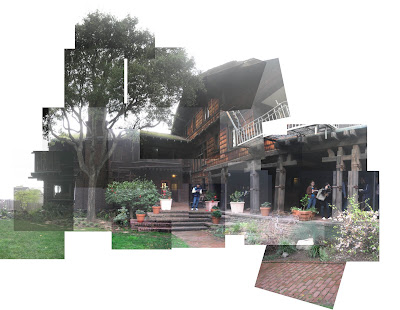
  Walking up the UC Berkeley Frat row is an aesthetic immersion all of it's own. You can find no shortage of Cal flags flying from houses of varying upkeep, decks with Christmas light decor piled with bikes and surfboards, spray-painted rush signs, some remaining evidence of thirsty Thursdays, the stereotype of the college experience visually exudes so severely from a few houses, they practically give you beer pong flashbacks. But not all the houses are like this and it was obvious upon approach which house we were there to tour, the outlier, the Thorsen house which stands distinguished and determined despite seeming out of place. We could even catch a glimpse of our tour guide straightening the curtains in the dining room window, preparing to show us with pride this last stand of the Arts and Crafts movement.

The house is huge, 10000 sq ft, but originally built for just a family of four and servants. Now it holds members of the fraternity Sigma Phi, unexpectedly enthusiastic stewards of the property. The Thorsen house was bulit in 1909 and is one of the four "Ultimate Bungalows" designed by the Arts and Crafts era firm of Greene & Greene. In addition to the house, the Greens were also commissioned to design much of the furniture that filled the house and to do some of the original paintings that adorn the walls of the living room and dining room.


There were so many beautiful details in the house, it was difficult to choose what to discuss. Some of my favorite parts of the house were the exotic hardwoods used in the entry, the winding floral pattern that glows through the front door stained glass windows, the iron tie designs found in the pillars of the backyard. Click the thumbnails if you want to see more photos from the trip on flickr. It seems like in almost every picture there is detail that could easily go passed unnoticed, but together create something more than the sum of its parts.


There are a lot of influences that come together harmoniously in the house. Sometimes the mixing of themes and perspectives creates a tension in a piece, but the Greenes were masters of their craft and wove in each piece beautifully. There are the Japanese influences that can be seen in the front door and torii motifs that can be seen in the porch columns. There are floral motifs in the handpainted wall sections, the tiling around the fireplaces, and in the stained glass that subtlety bring the nature surrounding the house indoors, an important element of arts and crafts era construction that wanted to create homes appropriate to the location. Even the owner's love of boats is built into the house, with the dining room and living room both pointing out like the bows of ships breaking through waves and a large painting of boats dominating the hall space. Rather than being a distraction, the elements were added in subtle details that are surprising and beautiful when you notice them. Nothing fights for attention. 


Greene and Greene were masters of detail and craft, didn't cut corners, and their careful thought and attention is evident in even the locks of the cabinets, the grain of the floor, the boat on the garden gate.

Tea Ceremony in 8 Haikus

Feb 10, 2010 | |


tea ceremony
enter, remove the world's dust
and enjoy your tea

kneel on tatami
listen to the tea kettle
watch the sparks and clouds

be in the moment
focus upon this time here
photograph later

each movement practiced
a ritual dance of calm
it's motion designed

beautiful objects
belongings of the future
lovingly cared for

green powder mountains
rest within a lacquer box
spoon by spoon it shrinks

black rakuware bowl
you see the imperfections
within you, wabi 

my apologies
for the quiet perception
my cough disrupted


At first the Tea ceremony seemed an adventure in time travel, to a place mostly forgotten in the pace of our culture, a retreat to a place of calm and strange juxtaposition. Where tea moved from shiny lacquer boxes to rough hand shaped bowls. The flammable paper walls and tatami mat floors held a hearth that could set the place ablaze. Careful and deliberate movements created a sense of calm and reflection. The entire experience was intensely detail-oriented in it's design from movements that moved the kimonos gracefully to the chabana that reflect the passage of time in a more appropriate way. I enjoyed a retreat from my normal reality.

But the second part, I'm sick, so about ten minutes in I felt the tickle in the back of my throat and what had been a time of thought and experience quickly dissolved into drawn out torture of trying not to cough. The quiet was the more apparent as I had nothing to muffle my cough behind. It seemed inappropriate to leave, not to mention difficult as we were closely packed, and even if I left, it had paper walls and would have accomplished little. I thought incessantly of the closet where my backpack held Robitussin but ignorant to proper etiquette about tea ceremony sick leave, I just prayed that my cough would pass. Prayed futilely. I understand that this seems silly to write about, but it's what I remember. Everyone was understanding, accommodating, but I think I missed a lot of what we were there to discover and I hope to one day get another chance to experience, sorry if I negatively affected yours. So, not my greatest Aesthetic Immersion, but they can't all be winners. The room was beautiful, our hosts knowledgeable and accomplished, and the information interesting, but the misery of sickness had a victory that day. Thank you for the tea, hope I'll see you again.


A kettle's-eye view.

In another class I'm reading the Tales of Genji so our teacher asked Ginny Dofflemeyer, a professor I've had twice before, to give a presentation that I found very enlightening as to the development of on Japanese aesthetic. In many pieces and within the concept of wabi-sabi there is an appreciation of asymmetry in the works. Early Japanese designs and layouts of cities and sites were often greatly influenced by the symmetrical designs found in China. Japan though is a very hilly environment which made such plans often time difficult to construct, especially for places such as monasteries, which by earlier edict had been required to be at the edges of towns and cities. More frequently in places where large symmetrical enclosures were impossible, smaller structures were created in multiple level spaces. Paths lead from building to building which created a flow, allowing experimentation with experience and asymmetrical spaces. As you follow a path, what do you see at each place, how do you control the next vista? Just one way Japan developed unique style from China.

This Week in Aesthetic Immersion: The Paramount Theater

Feb 3, 2010 | |

Last Friday we took another jaunt on the 51 bus, but this time in the other direction down to the Paramount Theater. Once the premiere movie palace of Oakland, it's now a California and National Landmark, a stunningly preserved monument to the Art Deco movement and the golden era of movies. The Paramount was designed in a time where great emphasis was put upon creating an environment so distinct from everyday life that it would transport you away from that reality into "a momentary Shangri-La" during your movie going experience. I imagine walking in from the street and entering into this other jungle-inspired world of luxury and the exotic and I'm not sure I'm ready to watch a movie, rather than to stare at the ceiling, stairs, the sheer size of the Grand Lobby. That's what hit me, the space is big and unexpected, the giant neon sign outside only a teaser to the drastic shift in scale you're going to experience. So it's a hard place to photograph. Looking at my first shots, it was clear that I wasn't quite capturing the scale, the grandeur, the emotion of the environment. It seemed I was only able to show small pieces, trying to capture detail work, the big picture was lost. The space is what struck me, so it's what I tried to show by combining my photos and looking at this in my blog, I think you need to click them and see the pictures full size.

The Grand Lobby


My favorite part was the lighting. The "windows" in the lobby maybe not be real but recreates the light of  a golden hour that will last forever. Underneath the balcony seating is incredible fixtures that remind me of giant glowing space flowers. And the ceilings, they were one of my favorite parts, vast back-lit lace. Our knowledgeable tour guide Ken told us that it's possible to walk on these ceiling sections, although we the public don't have access. It would be incredible one day to see the theater from a different perspective.
The ceiling inside the theater. 
This one got confusing so it's not the best, 
but the ceilings were one of my favorite parts. 
Ken gave a us light show, click the link and 
see the whole ceiling change color.


The Paramount was designed during the glamorous era of the roaring twenties, but within a month after the property was bought the stock market crashed, bringing economic crisis that would last a decade. Paramount Publix decided to continue with construction as planned and the theater was completed in a remarkable year and five days, staying on budget by clever use of materials and planning. Despite the increasingly desperate economic climate, the Paramount opened with fanfare, celebrities and ceremony. It was forced to close its doors six months later, and sat empty and dark for decades. The best show in town waiting for a better day.


Always the best show in town

It was weird to walk around the theater and think about the Paramount sitting in disuse for so many years, slowly falling to the wear of time. It's a space where all the details were considered important and were carefully crafted, and after only a short time in the sunshine so to speak, they were locked up and ignored.

My last trip to Peru, I walked with some friends to the ruins of Pumamarka, an unrestored Incan site above the town of Ollantaytambo where we were living. It's a long hike but there are two ways to get there, you can walk a path through the forest or alongside the winding road. We chose the path, it's longer but far more adventurous, a well worn trail for the first couple hours, then a bit more intuitive for the next. There's not much back there, some houses, farms, gated yards, but the forest become denser as you retreat from town. And then suddenly a white-walled complex of large empty rooms, no glass panes in the windows that overlooked an overgrown courtyard, ready and wired for electricity but connected to nothing, an unfinished space that nobody was trying to complete so instead the forest had started its reclamation. Before the recession, when people still were traveling there had been the reason and means to create what I heard was suppose to be a luxury hotel, the largest in town, but then tourism slowed and construction halted. It sits in wait, decaying and more than a little creepy. 

An easily imagined timeline of a building's life might go something like: plan building, build it, occupy it (different groups may come and go), fix it occasionally, and when it's too old, tear it down and repeat. But architecture seems to reach for new heights and superlatives in times of building booms, attempting to create the most modern, or most lavish, or the greatest engineering feats. When the bubble bursts, mass abandonment. The Paramount was completed almost within the first year of the depression and stayed open only 6 months, that to me seems like barely making it. In this recession we experience the same phenomenon, except maybe worse. The entry Ruins of the Present from Bruce Sterling's blog (he is also the author of the Shaping Things book from History of ID) touches upon the lack of a word for uncompleted abandoned building projects that are the new trademark of the places that just a few years ago would see the same building as a symbol of progress and growth. They aren't ruins, but what exactly do you call a building that never gets used? Sculpture? The Wapato Jail in Portland, Oregon never accepted a single inmateafter completion, so is it still a jail? And what do we do with these creations?

When the Oakland Symphony bought the building in the 70s, they had to do a major restoration to bring the theater up to snuff, but it was given a second life. Now owned by the city, it is the home of the East Bay Symphony and is "one of San Francisco Bay's premiere performing arts facilities" -Paramount. We are lucky to have the Paramount around and today we can look at it as a beautiful example of American art deco, but I'm sure it wasn't looking so rosy the day they shut the doors in 1932. Things aren't looking great now for our "squelettes" but perhaps like the Oakland Symphony, it's artists that can save them.

The Bone Room and the Rise of the Scavengers

Jan 27, 2010 | |

A short trip on the 51 bus brought us to the Valley Life Sciences Building on the Berkeley campus for our second Aesthetic Immersion field trip. We were there to do a bit of exploring in the university's private Museum of Vertebrate Biology and see "one of the coolest rooms on campus", the Bone Room. Our knowledgeable tour guide this time was Alan Shabel, a lecturer and graduate of Berkeley, who explained a bit about vertebrates and the study of comparative morphology, then impressed with his questionmaster abilities.


The Museum of Vertebrate Biology holds one of the most impressive collections of amphibian, reptile, bird and mammal specimens in the country, possibly the world. Aisles of metal cabinets each contain numerous samples of each critter type, identified on the font only with scientific name and region. One might be rodents (probably rodents evidently, since they are extremely diverse and numerous) or maybe frogs or whales. Back a bit further though and you enter the Bone Room. A room lined with shelves with so many skulls looking back at you, limbs and baleen and other parts that I couldn't place and neatly labeled boxes containing more.


The variety in the forms of the skulls we saw surprised me. In many ways they are remarkably similar, once they reach the bone room they are vaguely the same color, they more or less have the features we can recognize as eyes or mouth, there are so many there that indiscriminately wandering the aisles can make a blur of the individual pieces. But each of these animals has developed adaptation to it's environment and way of life, whether it's the krill harvesting baleen of a gray whale or the locked jaw movement of otters.


I flipped through the pages of my notebook last night looking for any scribble that might inspire a blog post and in the mix of my poor note taking and absent minded lecture doodles was the word kleptoparasitism. Alan used the term in reference to how paleontologists had believed that velociraptors stole eggs from other dinosaurs. Its a term that also describes those that steal from other animals who have caught, prepared, stored food or nesting material. It can occur where theft is from others of the same species or another species entirely. There are many cases of this behavior in bugs, between lions and hyenas, a few species of birds and according to wikipedia sometimes humans chase lions away from their prey in kleptoparasitic style. But it seems that we as a species participate in a few more variations of kleptoparasitism than that. For generations we took what was prepared by others, honey from bees, milk from cows, eggs from chickens. We have raised truffle finding pigs, dogs to hunt our prey, and sap to make maple syrup, etc. We cut down the homes of many species to build our own. We may be the biggest kleptoparasites of them all. On a larger scale, we as a species have taken whatever we please from an environment that otherwise has been able to maintain balance for thousands and thousands of years. Its been a remarkably effect method of growth, but at this point is clearly unsustainable, so how can we change our development pattern to better integrate with the rest of the natural world? Its a tough question.

We have been successful, but the other winners of our method is the scavengers. While many suffer from decreased resources and expanded human population, those creatures that can adapt to using what we have put in place have also experienced massive population growth. Rats, raccoons, flies, other now urban dwelling creatures. As resources diminish we may very well have to take cues from the scavengers to take advantage of the situation that we created. They have adapted to us, how can we adapt to us?

Berkeley Marine Center

Jan 20, 2010 | |

From my neighborhood, I think I'm the only kid who never took sailing lessons. I even registered twice but family camping trips and torture, like summer piano lessons, always seemed to conflict. It's actually rather improbable that I never learned how to sail, my family on my mother's side seemingly has some sort of genetic attraction to the windy seas and I myself love almost all boat travel despite the fact that I occasionally can't remember whether starboard is the right or left side of the boat (it's the right) and pretty much my grasp of nautical vocabulary is limited to the more colorful colloquialisms attributed to sailors... But still, I'm sure that some of this family history contributes to my enthusiasm for my recent outing. Or maybe I just love field trips.


Last Friday, the Aesthetic Immersion class headed out for it's inaugural field trip to the Berkeley Marine Center. We met first with Jim Antrim, a naval architect who works designing and building boats and parts for existing boats, making them fast, light weight and when working with some of his more "creative" some clients, functional despite looking like giant metal bugs... or the such. His slideshow accompanied by soothing background music was interesting, but then we actually got to explore the boat yard and see the current sailboat in progress. My first impression, the amount of sanding required to make these boats is incredible, and the patience and the willingness to be covered in dust for potentially months is currently beyond my understanding.


Further in to the yard though, what struck me was the stark contrast between the product and the environment. They turn out these beautiful boats, sleek and shiny, they look fast and practically flawless. But the boat next door may very well be looking more like a giant decaying barrel surrounded in nautical refuse. Broken buoys and motorcycles and masts laying everywhere, a giant boat-making version of my own desk mid-project. And it was cool, so many industrial designers create nice shiny objects without thinking of the end life it was fun too see both the process of creation and it's return to decay in the same spot. Broken they may be but with history and experience exposed by the wear and tear. They wait hoping for that eventual restoration that will give another chance for adventure, and as a sign that evidently, it's all fixable. I like broken boats.


Which seems to fit in rather well with my family boating legacy, because in truth, that family history of boating involves partial sinking/crashing/being unable sail back from Cuba after being caught by the Coast Guard more than a couple boats. Its great to see these boats they craft with all the marvels of new materials and engineering, but as interesting to me to see where they might be in 50 years. When the weather and water or another ill-fated Olivier sailor has taken it's toll, it may be a bit worn, but it could sure show some interesting stories.

Design Observation Blog - Bus Pushing

Dec 6, 2009 | |


One private coach bus died and so to keep it moving another came and slowly pushed it down the street. When I knew I had to grab my camera is when I saw they were going to try a turn. The bus in the back gave a push and while it seemed a little iffy, the were successful. One thing we noticed is that in those buses the driver is usually at the very front of the coach, which makes the guy giving the push a great view of the impending back of the guy in the front. It would make me nervous. The main point I wondered about was, is there a better way? There has to be, since I believe most forms of transport contact is considered bad. Why didn't the guy wait for a tow? Or is it just as good of an option and the bus company or buses removed the unnecessary middle man of a tow? Do you have to design a tow truck differently for a bus than a car? Maybe my next interview should be bus drivers.

Design Observation Blog - Making Do.

| |


Bonus: What do you do if you don't have cue chalk? Bust through the paint and use the gesso ceiling of course. Not obvious from the photo, but that ceiling has tons of little holes.

Design Observation Blog - BART Info

| |


This a photo I took during my awesome intercept interviews I thought it was funny. Directly in front of a sign with all sorts of info written in small little type, there is a trashcan in the way. But since BART has the big signs to tell us when the next train is coming, maybe a trashcan is more important anyways.

Design Observation Blog - Marta!

| |


Marta is one of the people I interviewed for our final projects and also one of my roommates. She comes from Santiago, Chile and during our interview, shared many stories about cultural differences between Chile and the United States. One of my favorites was about bread. In Chile, and other parts of Latin America from my experience, it's more common to buy fresh baked bread than bread from stores. Sliced bread would be sold in stores, but is more expensive so in Chile she thought of sliced bread as a rich people thing. Here it's the opposite, to buy fresh baked bread daily would be a "rich" thing and the cheapest bread varieties usually come sliced. I want fresh bread delivered daily. How can we make that happen?

Design Observation Blog - Electrical Inspiration

| |


I don't know if this is an intentional design decision, but I thought it was pretty cool. At the PG&E in Emeryville, the lights are seemly inspired by the equipment they have within the fenced area. It's an interesting way to reflect what is the nature of the fenced area.